
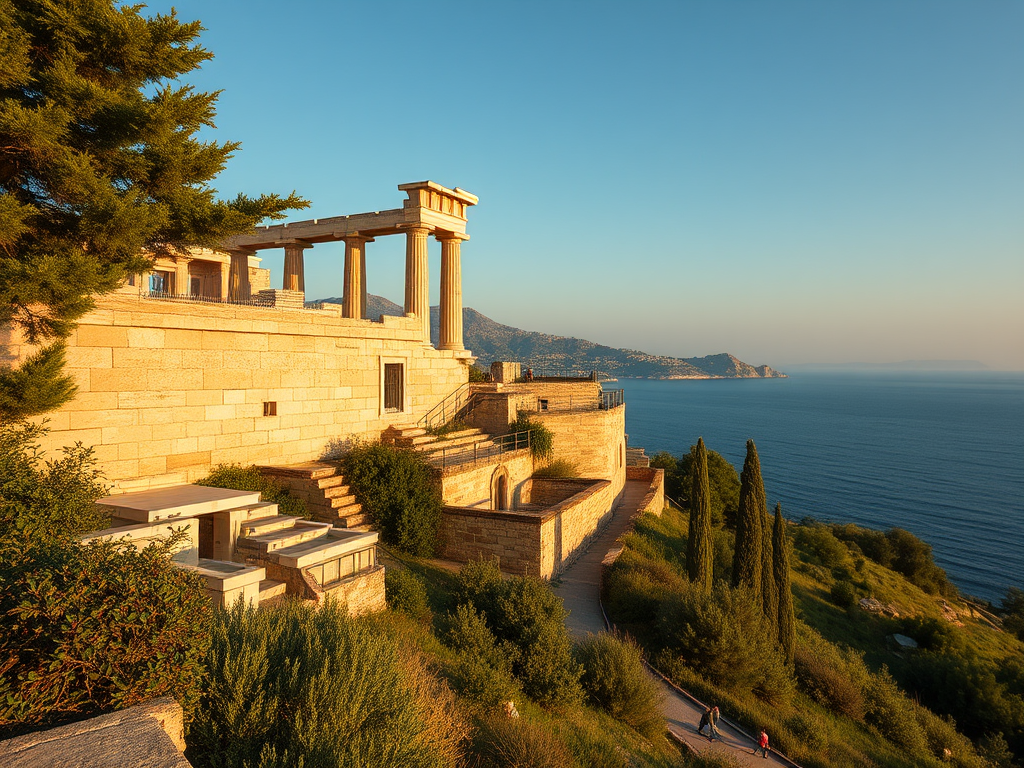
In Greek mythology, Kithera is home of Aphrodite, the goddess of love, beauty and sexuality, who was born after Cronus cut off Uranusʼ genitals and cast them into the sea. Kitheraʼs Paleopolis beach, where to this day there are remnants of temples built in Aphroditeʼs honor, is where she is said to have emerged from the foams of the Aegean.
I arrived in a less dramatic fashion, on the one daily flight from Athens to the island. The small propeller plane seated all but 37 passengers.
“Donʼt worry about finding me at the airport,” my friend Dimitra had said. “Itʼs only about as big as your house.”
As it turned out, she wasnʼt exaggerating all that much.
Perched in my window seat, my eyes were glued to the vast deep blue Mediterranean beneath me. It was dotted with hundreds of islands, big and small, and I wondered which one was Kithera. I knew absolutely nothing about my destination. Traveling via Germany, all of my well-traveled German friends had shrugged when I told them I was going to Kithera.
“Never heard of it,” was the standard reply.
Even the Google search proved tricky because I found at least five different spellings. Kithera. Kythera. Kythira. Cythera. Kithyra. Were they all the
same island? Or maybe related? I eventually gave up and decided that I would simply submit to the unknown and the element of surprise.
The first was the topography that came into focus as the plane descended. The island is about 35 miles long and 20 miles wide. Patches of green and vast olive groves are nestled into rugged, mountainous volcanic rock terrain. Narrow roads snake up and down steep hillsides.
Most prominent, though, were the rock walls. From birds-eye view, they covered the island like a spider web. Because they appeared only about a foot or so tall, their purpose was not immediately apparent. They certainly werenʼt high enough to keep out intruders. And they enclosed completely empty lots, without any houses or structures.
“Theyʼre demarcation lines to separate the properties,” Dimitra explained, as we loaded my suitcase into her SUV. “Greece does not have a land records office. Ownership can be established only by consulting church records, or through family lore and the ancient boundaries.”
As we headed for the dusty two-lane country road that led away from the airport, she gave me a few stats.
“Most of this island is undeveloped. There are very few tourists, no chain hotels, no fast food places, no shopping centers, and no highways.”
“No tourists?” I asked skeptically.
“Nope,” she said. “There are about 3,500 year-round residents on the island. In the summer, that number swells to about 30,000 people … “
“ … but you said no tourists!” I interjected, a bit too hastily.
“Thatʼs because they are not tourists,” Dimitra continued patiently. “There were about 30,000 people on the island before the Second World War. After the war, amid high unemployment and austerity, most of them immigrated to Australia. And now their children and grandchildren come back every year to spend the summer and their Australian dollars here. But they all leave in early September and then life on the island gets back to normal again.”
This explained the relative absence of traffic, since we were already well into September.
I was impressed by how expertly Dimitra negotiated the hairpin curves and steep narrow roads with the skill of a Paris-Dakar rally driver.
“Iʼm glad youʼre driving and not me,” I joked.
“This is nothing. Most roads are much narrower than this,” she said, as we entered the village of Avlemonas. And as if to prove a point, she folded in the side mirrors of her car to allow another car to pass us without collision.
“When I first came to the island and was invited to a friendʼs house,” she reminisced, “he told me that he hoped that my car would not break down because if it did, Iʼd be stuck, literally.”
It turned out that the road to his house led through a village with streets so narrow that there was not enough room on either side to open the car doors; the car would have been stuck between the houses.
“Iʼm going to pick up some Greek pizza for lunch,” Dimitra said, as she was parking haphazardly pretty much in the middle of a small square, among a bunch of other cars parked equally haphazardly in no particular order.
Considering that the square, a confluence of five small roads, was only about as big as a 7-Eleven parking lot, it was certainly a busy place. Brightly painted tables and chairs were set up in front of every building and shop.
That, as I soon would learn, is because most social activity on Kithera takes place al fresco. The people sitting at those tables drink coffee, play backgammon, or simply talk to one another in the most unhurried fashion.
Greek pizza is made with phyllo dough and feta cheese and it gave my taste buds a first flavorful inkling of things to come. Pretty much everything I ate during my week on Kithera tasted delicious and fresh and Greek, infused by mouth-watering herbs and spices.
Kithera soon became a kaleidoscope of colors, tastes and fragrances to me: Sweet smelling fennel, hardy rosemary and thyme, and soothing camomile, all growing wild and giving off their alluring scents.
The fig and olive trees were laden with fruit, and Dimitra simply reached across someoneʼs fence, pulled a few off a tree, and presented me with the first fresh fig of my life. A huge tin canister in her kitchen held oil from the olives harvested on her land.
The apartment was only a two-minute walk from the scenic beach in Capsali. We quickly settled into a routine for the week. Every day started on the sun-kissed patio under a large palm and some fig- and pomegranate trees. After a breakfast of strong Greek coffee, delicious yoghurt that came in earthenware pots, and fresh fruit and sweet rolls, we would head out to explore a different beach, usually with some stops along the way to do some sightseeing and shopping.
Shopping on Kithera is an experience reminiscent of a different era. There are no shopping centers. The shops are in the middle of the town and invite the casual browser to come in and take a look. A hardware store, where we went looking for baskets, seemed more like a dry goods store in an old Western movie, with merchandise stacked to the ceiling, an earthy smell, and two sales clerks behind sturdy wooden counters, ready to wait on us and take orders.
Back on the street, a sweet scent lured us in the direction of a small bakery where the owner was pulling almond cookies and lemon squares from the oven. She quickly brought out a tray of samples and urged us to dig in. And the owner of the souvenir shop insisted on giving me a small gift, some fennel seeds wrapped in gauze and tied with a pretty ribbon, which took some explaining to the customs agents at Dulles (“really, theyʼre just fennel seeds!”)
With summer all but over and fall not quite here yet, time passed languidly. Some of the beautiful beaches were already pretty much deserted and we had them to ourselves. Equipped with iPhone, iPads and an Internet connection stick, Dimitra would set up her mobile office next to her beach chair and weʼd spent the afternoons reading, writing, relaxing and soaking up the beauty of our surroundings.
And talking about life on the island, which is something Dimitra never gets tired of doing. Sheʼs spent the last five summers here, knows the island like the back of her hand, and she also knows the people.
“You have to be careful about Greek men,” she said.
I didnʼt think Iʼd have to worry about that, but I nevertheless listened with amusement when she told me one of her experiences.
On morning, when she was alone at the beach, a young man sheʼd met casually through a friend plopped down next to her, took off his clothes, and propositioned her. Although she loves to flirt, she told him that she wasnʼt interested, and that, by the way, he was married, and she was old enough to be his mother. So her Adonis just shrugged, put his clothes back on, and left. When she later told the friend whoʼd introduced them about the incident, he shrugged too and mumbled something about an “Oedipus complex.”
My afternoons at the beach were boring by comparison. I would read, take movies with my iPad, or collect rocks. The rocks on the Greek beaches are absolutely beautiful. They come in a myriad of shapes, sizes, colors and textures and forced me to make the biggest decision of the week: Which ones to keep and home and which ones to toss reluctantly back into the water.
Occasionally, Dimitra would announce, “I have to pee”, which was the signal to head for the water. Europeans are pretty informal about that kind of thing. The water was as crystal clear as if it were coming from a faucet, with every pebble on the ocean floor magnified through the prism of water.
Then weʼd head back to our beach chairs and soak it all in: the endlessly cloudless blue sky, the vast still blue sea, the rugged mountain ranges, dotted with dozens of picturesque white byzantine chapels, all baked in bright sunshine.
At sundown, weʼd pack up and get dressed ‒ which, on the island, meant tying a pareo over our bathing suits ‒ and head home to shower and change before going out to dinner.
Usually, Dimitra would ask,
“What do you want to have for dinner tonight?” and Iʼd say
“Moussaka” or “Iʼm game for anything”, to which she would reply,
“I know just the place to go.”
And she always did. She usually knew the owner of the taverna, his specialty, and the perfect place to sit, making every dining experience a memorable one.
Most of the restaurants we visited didnʼt even have a menu. I quickly became accustomed to our nightly dining routine: Once we had settled on a place, almost always outdoors, a waiter would rush over to cover our table with a white tablecloth and bring a bottle of water, a jug of wine, a loaf of crusty warm bread, and a plate of olive oil for dipping. Then the owner would come over and rattle off the menu, and Dimitra, who speaks Greek fluently, would order for us.
Occasionally, the owner would invite us into the kitchen, let us inspect the pots, and pick our own meal. Tzaziki (a wonderful dip made of farmerʼs cheese, olive oil, cucumber and garlic), dolmadokia (stuffed grape leaves), and tapenade (a paste of ground olives) soon became my favorite appetizers. For main courses, we regularly enjoyed keftidis (meatballs made of ground lamb), souflaki (succulent chicken kebobs), and moussaka, the Greek national dish, a flavorful casserole of ground lamb, potatoes and eggplant.
It also didnʼt take long to get used to our nightly carafe of Greek table wine, a wonderful dry white wine that resembled Chablis.
Our most special dining experience was on a Saturday night, when Dimitra invited her friend Ionopoulos, a young entrepreneur in his mid-thirties, to dine with us at her favorite seafood restaurant on the other side of the island.
It was untypically windy on the island that day, and wherever we went, the sentiment was the same: “Itʼs going to rain.”
Thatʼs because it had not rained all summer. And indeed, the air felt and smelled like rain.
That didnʼt faze the patrons at the taverna. The vast courtyard in front of the barn-like structure was lined with long tables and benches. Gigantic maple trees bowed over the square, with lights strung across their branches. The wind whipped their crowns, softly swaying the lights in the dark night sky.
“This is our favorite place to eat fresh fish,” Dimitra said, and then she started to order: A Whitefish, prepared on the grill, with sides of eggplant, green beans, tender squash, white beans, and orzo.
The cats arrived even before the appetizers. Cats are everywhere in Greece. Mangy, skinny, small cats that run wild, travel in packs and beg for food.
“Donʼt feed them or we wonʼt get rid of them,” Dimitra said.
That was easier said than done because there were dozens of them, and they werenʼt shy. We finally threw them some fish bones to get them away from the table.
Against all odds, the weather held that evening and it did not rain. The wind was still whipping the trees when we left around midnight, fortified with some strong Greek coffee and ouzo.
“Letʼs check out the beach,” Dimitra suggested. “Thereʼs supposed to be a big wedding tonight.”
Weʼd seen them set up tables on the boardwalk earlier in the afternoon and now, after midnight, as we headed down the mountain toward scenically illuminated Capsali, the wind carried the mandolin and tambourine sounds across the night air.
We picked a table in one of the boardwalk cafes and observed the spectacle: Several hundred wedding guests, seated at lavishly decorated round tables by the water, and an ample buffet laden with Greek delicacies. The dance floor was full of people dancing the sirtaki. They were clapping and encircling the
groom and the bride, who coyly gathered the many layers of her billowing wedding dress to fall in step with her new husband.
“Theyʼll be dancing until morning,” Dimitra predicted. “Greek weddings last several days.”
We only lasted until about 2 am. The music could be heard even from the apartment, but as soon as we closed the patio doors, it happened: The thunder and lightning that had been ongoing all night long released into a torrential downpour and put an end to the music. I felt sorry for the wedding party broken up by the untimely rain.
The next morning we went to one of the caféʼs on the beach for breakfast. So did most of the wedding guests, who stayed in the village and were now also in search of strong coffee. Our waitress volunteered that the rain had not stopped the wedding celebration.
“They just moved inside,” she said. “The last people left at 8 am.” I left Kithera a day later for Athens on the commuter plane, gazing melancholically at the blue paradise below me. Adio. Efharistó. Iʼll be back.

 Ruth Boggs' Blog
Leave a comment